Synthesia vs Deepbrain AI (2025): Which Enterprise Video Tool Wins?
When evaluating the premium tier of the Synthesia vs Deepbrain AI landscape, the choice isn’t just about creating videos—it’s about choosing between scale and hyper-realism. As a specialist in AI Video Generator tools, I have pushed both platforms to their absolute limits.
Marketers and enterprise leaders often feel the pressure to produce high-quality content faster than humanly possible. You need a solution that removes the bottleneck of traditional filming while maintaining brand integrity.
In this battle-tested comparison, I will break down the avatar quality, unique enterprise features, and ROI to help you decide. We are determining which tool delivers the best AI Avatar experience for your specific business needs.
Table of Contents
Quick Verdict: Synthesia vs Deepbrain AI – Which Fits Your Business?
After extensively testing both platforms for corporate clients, my verdict is clear based on use case. Synthesia is the “Apple” of this industry—polished, intuitive, and designed for mass adoption.
Deepbrain AI, however, is the specialized “broadcast station” focused on visual fidelity. If your priority is scalability across a large team, Synthesia wins. If you need an avatar that can fool a news audience, Deepbrain leads.
- You need a polished, easy-to-use interface for a large marketing team.
- You require massive language support (140+) for global localization.
- You value collaboration tools like workspaces and commenting.
- You demand “Hyper-realistic” avatars (broadcast grade) to minimize the uncanny valley.
- You need the specific AI Interview feature for HR and recruitment.
- You plan to deploy interactive AI Kiosks for customer service.
Try Synthesia Free
or Explore Deepbrain AI
(Disclosure: If you purchase through links on this page, we may earn a small commission at no extra cost to you. This helps us maintain our “battle-tested” reviews.)
Avatar Quality & Realism: “Express-2” vs. “Hyper-Realistic”
The core differentiator in the Synthesia vs Deepbrain AI debate is the philosophy behind their avatar modeling. Synthesia focuses on emotional versatility with full-body realism, while Deepbrain AI chases absolute visual perfection.
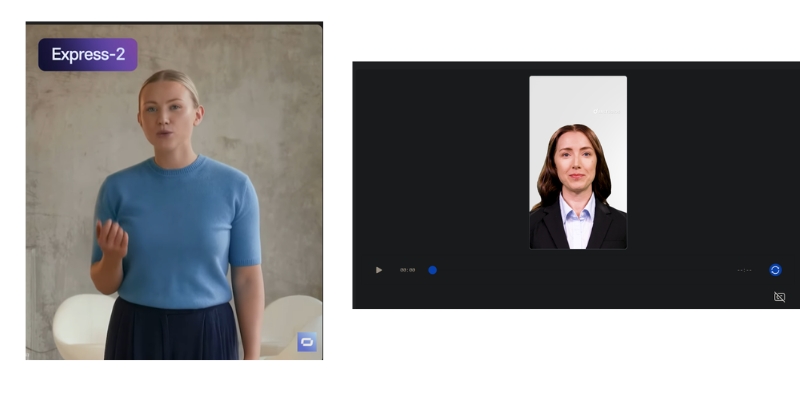
Synthesia’s Express-2 Avatars (Synthesia 3.0):
I found Synthesia’s latest Express-2 model—launched in September 2025 with Synthesia 3.0—to be a revolutionary leap. These are now full-body avatars with natural hand gestures and body movements that mimic professional speakers, not just talking heads.
The Express-2 model uses billions of parameters (compared to millions in the previous EXPRESS-1), enabling sentiment analysis that adjusts facial expressions—smiling when the script is happy, frowning when serious. This “Emotional Intelligence” combined with frame-accurate lip sync at 1080p/30fps makes them perfect for corporate training and marketing videos.
You can even prompt-generate custom avatars with specific appearances and place them in any environment (office, beach, construction site). However, close-ups can sometimes reveal their digital nature. They are designed to be safe, clean, and universally acceptable for business environments.
Deepbrain AI’s Hyper-Realism:
Deepbrain takes a different approach with its broadcast technology heritage. Their avatars are Hyper-realistic, often indistinguishable from real news anchors. I noticed fewer artifacts around the mouth and eyes compared to competitors.
This high fidelity comes with a trade-off. While visually superior in static shots, the movements can sometimes feel stiffer than Synthesia’s fluid full-body gestures. Deepbrain is the choice when “visual trust” is paramount, such as in financial reports or news-style content.
Core Features Comparison: Creating Video Content at Scale
Beyond the avatars, the actual workflow determines your team’s efficiency. I compared how fast I could go from a blank page to a rendered video on both platforms.
The Editor Interface:
Synthesia uses a slide-based editor that feels exactly like PowerPoint. If you can use Google Slides, you can use Synthesia. This lowers the barrier to entry for non-technical staff significantly.
Deepbrain AI’s AI Studios interface is more timeline-based. It offers more granular control, resembling a simplified video editor. It is powerful but has a slightly steeper learning curve for beginners.
Templates & Assets:
Synthesia dominates here with over 300 professionally designed templates. They are aesthetically consistent and cover every corporate use case imaginable. I rarely had to design anything from scratch.
Deepbrain offers 100+ templates, which I found more niche-focused (News, Financial, Kiosks). While specialized for specific industries, they lack the uniform “Silicon Valley” polish and variety that makes Synthesia’s templates so versatile for general business use.
Scripting Tools:
Deepbrain integrates ChatGPT directly into the editor for robust script generation. Synthesia counters this with an “AI Video Assistant” that can generate entire scenes, including layout and images, from a simple prompt.
Unique Selling Points: AI Interview vs. Collaborative Workspaces
This section reveals the “dealbreakers.” These unique features often decide the winner for specific departments like HR or Marketing.
Deepbrain’s AI Interview:
This is a game-changer for HR professionals. Launched in May 2023 and powered by GPT-4, Deepbrain allows you to generate interview questions, conduct automated video interviews where an AI avatar asks the questions, scan resumes, and generate interview summaries. Synthesia does not offer this functionality.
Deepbrain’s AI Kiosks:
We also tested Deepbrain’s ability to power real-time conversational kiosks. This offline/online integration makes it a unique solution for banking halls, hotel receptions, and convenience stores, moving beyond just video creation into interactive customer service.
Synthesia’s Collaboration:
For my marketing team, Synthesia is superior because of its “Workspaces.” We can comment on specific timestamps, share assets, and manage permissions effortlessly. It feels like using Google Docs for video.
Voice & Language Capabilities: Reaching a Global Audience
If you are a global enterprise, localization is not optional. I tested the Text-to-Speech (TTS) engines to see which sounded less robotic.
Language Count:
Synthesia leads with support for over 140+ languages and dialects. Deepbrain AI supports 80-110+. For companies expanding into smaller markets, Synthesia’s broader coverage is a critical advantage.
Voice Quality:
Synthesia leverages top-tier voice technology (similar to ElevenLabs). The intonation, pauses, and breathing sounds are shockingly natural. Deepbrain is excellent, but I detected slight robotic cadences in longer, complex sentences.
Auto-Translation:
Both tools offer one-click translation. However, Synthesia’s ability to clone your voice and then speak another language (in the Enterprise plan) adds a layer of personalization that Deepbrain struggles to match.
Pricing & Plans: Comparing ROI for Enterprises
For the high-budget buyer, price is secondary to ROI. However, understanding the entry point helps justify the investment to your CFO. Here is how the pricing models stack up.
| Feature | Synthesia (Starter/Creator) | Deepbrain AI (Starter/Pro) |
|---|---|---|
| Starting Price | $18 / month (billed yearly) $29/month (monthly) |
$29-30 / month (billed yearly) |
| Video Minutes | 10 mins/month (Starter) | 10-15 mins/month (Starter) |
| Custom Avatars | Add-on ($1000/year) | Enterprise Only |
| Key Strength | Ease of Use & Scale + Full-Body Avatars | Realism & AI Interview |
| Action | View Plans | View Plans |
Starter Plans ($18 vs $29-30):
Synthesia offers a significantly lower entry point at $18/month (billed yearly). Their “Starter” plan is perfect for individuals testing the waters. Deepbrain’s premium positioning is reflected in its higher starting cost of around $29-30/month.
Enterprise Custom Comparison:
At the enterprise level, both offer MSA, SLA, and dedicated support. However, Synthesia includes more “seats” for team members, making it more cost-effective for large departments collaborating on projects.
ROI Analysis:
If you use Deepbrain’s AI Interview to screen 100 candidates, the ROI is immediate in saved HR hours. If you use Synthesia to replace a $50,000 training video production, the ROI is equally massive.
Frequently Asked Questions About Synthesia vs Deepbrain AI
Here are the specific questions I often hear from clients deciding between these two giants.
Which tool is more realistic?
Deepbrain AI generally wins on static visual fidelity and texture (“Hyper-realistic” faces). Synthesia’s Express-2 wins on full-body movement, natural gestures, and emotional expressions, reducing the “zombie” or “floating head” effect.
Does Deepbrain AI have a free trial?
Yes, Deepbrain AI typically offers a free trial or a demo video generation, similar to Synthesia’s free video generator page. You can test the rendering speed before buying.
Can I use these tools for YouTube automation?
Yes, but be careful. Platforms like YouTube require you to label AI content. Both tools are excellent for faceless channels, but Synthesia’s variety (300+ templates and customizable full-body avatars) keeps content fresh.
Is Synthesia better for teams?
Absolutely. Its workspace features, shared libraries, and commenting systems are far superior for collaborative workflows compared to Deepbrain’s more single-user focus.
What is the best alternative to both?
If neither fits, Colossyan is a strong contender for corporate learning, offering unique features like side-view avatars and conversation mode.
Read More From AI Video Generator
Dive deeper into our expert analysis to find the perfect tool for your specific needs. We cover everything from free alternatives to enterprise solutions.
- Colossyan Review: Enterprise AI Avatars Put to the Test
- 10 Synthesia Alternatives (Free & Paid)
- How to Use Deepbrain AI (For Enterprise)
- Best AI Avatar Generator of 2025
last update : 20/11/2025