
Luma Dream Machine Pricing: Plans, Credits & Hidden Costs (2025)
When you investigate Luma Dream Machine pricing, you are not just looking for a number; you are calculating the ROI of your creative time. As an expert in generative AI tools, I know that for marketers and creators, the real cost isn’t just the monthly subscription.
It is about the cost of failed generations, the value of commercial rights, and the speed of your workflow. The industry is under immense performance pressure, and waiting for a render can kill your momentum.
In this battle-tested guide, I will break down the Free Plan, Lite Plan, Plus Plan, and Unlimited Plan to help you decide exactly where to invest your budget.
Table of Contents
Luma Dream Machine Pricing Overview: Is It Worth the Investment?
Luma Dream Machine operates on a freemium model that is becoming the standard in the generative AI space. It uses a credit-based system where every action, from generation to extension, costs credits.
For casual users, the Free tier offers a generous 500 credits monthly to experiment. However, if you are a professional facing tight deadlines, the “Performance Pressure” of watermarks and non-commercial restrictions will quickly push you toward paid tiers.
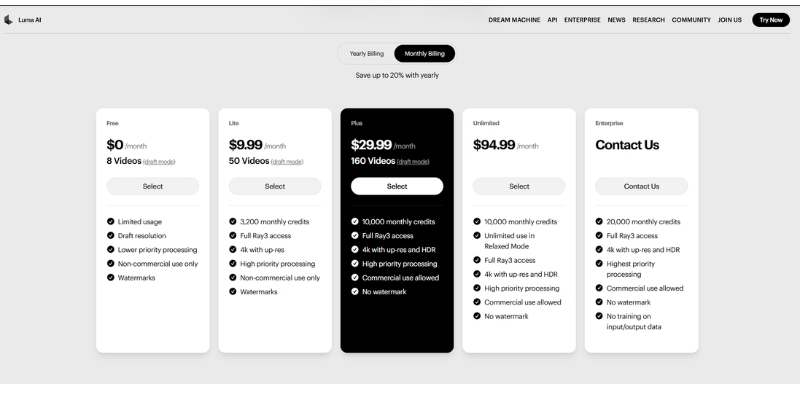
Below is a quick summary of the current pricing structure updated November 2025. Note that these plans are designed to scale with your production volume, from experimental clips to commercial campaigns.
| Plan Tier | Price (Monthly) | Monthly Credits | Key Benefit |
|---|---|---|---|
| Free | $0 | 500 | Risk-free testing |
| Lite | $9.99 | 3,200 | Priority Processing |
| Plus | $29.99 | 10,000 | Commercial Rights + No Watermark |
| Unlimited | $94.99 | 10,000 Fast + Unlimited Relaxed | High-Volume Production |
Lite Plan ($9.99/mo): This entry tier gives you 3,200 credits with high-priority processing. However, it retains watermarks and is for non-commercial use only, limiting professional applications.
Plus Plan ($29.99/mo): This is the sweet spot for professionals. It removes watermarks, grants full commercial rights, and provides 10,000 monthly credits—enough for consistent content creation.
(Note: Prices are accurate as of November 2025 per Luma Labs official pricing page.)
Breakdown of Luma Dream Machine Pricing Plans (2025 Updated)
Choosing a plan is not about the price; it is about the “Cost per Usable Second.” In this section, I will dissect the specific ROI of each plan for Marketers and Creators based on real-world testing.
The Free Plan: Good for Testing, Not for Pros
The Free Plan provides 500 credits monthly—significantly more generous than previous iterations. This allows for substantial experimentation before committing to a paid plan.
Strict Watermarking: Every video you generate will have a prominent Luma watermark. This renders the footage unusable for professional client work or high-end social media channels where brand consistency matters.
Non-Commercial License: You cannot monetize these assets. If you use a free clip in a monetized YouTube video or a client’s ad campaign, you risk copyright violations per Luma’s Terms of Service.
Standard Queue: Free users are placed in the standard processing queue. While not as slow as some competitors, expect longer wait times during peak hours compared to paid tiers.
The Lite Plan: Priority Processing Without Commercial Rights
At $9.99/month, the Lite Plan offers 3,200 credits—a substantial jump from the free tier. This plan targets hobbyists and students who need faster processing but don’t require commercial licensing.
High Priority Processing: Your generations jump ahead of free users in the queue. This dramatically reduces wait times, allowing for a more efficient creative workflow.
Full Ray3 Access: You gain access to Luma’s advanced Ray3 model, which delivers superior lighting, physics simulation, and overall realism compared to basic models.
4K Upscaling: The ability to upscale to 4K resolution makes your outputs suitable for high-resolution displays and presentations, though watermarks remain.
Non-Commercial Restriction: This is the critical limitation. You cannot use Lite plan outputs for any monetized content, client work, or commercial projects. It’s strictly for personal portfolios and learning.
The Plus Plan: The Professional Standard
For $29.99/month, the Plus Plan is where Luma becomes a professional tool. With 10,000 monthly credits and full commercial rights, this plan serves freelancers, content creators, and small agencies.
No Watermark: Your videos export clean and professional. This is non-negotiable for client deliverables and branded content creation.
Commercial Rights Included: You own the output and can monetize it across all platforms—YouTube ads, client campaigns, paid social media, and commercial products.
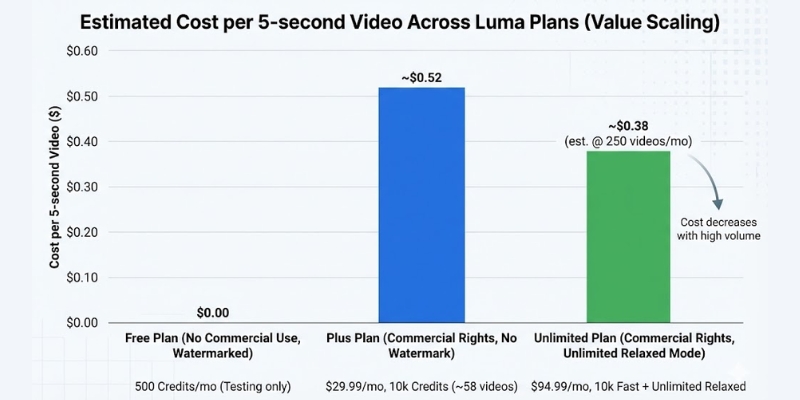
10,000 Credits Strategy: In my testing, 10,000 credits translates to approximately 58 video generations (at 170 credits per 5-second clip). With careful planning, this supports 2-3 substantial projects monthly.
4K + HDR: The Plus plan adds HDR (High Dynamic Range) support, giving your videos that cinematic “pop” with enhanced color depth and contrast.
The Unlimited Plan: For High-Volume Creators
At $94.99/month, the Unlimited Plan targets agencies, production studios, and full-time content creators who generate dozens of videos weekly.
10,000 Fast Credits: You still get 10,000 “fast mode” credits for high-priority processing. These work identically to the Plus plan for urgent projects.
Unlimited Relaxed Mode: This is the game-changer. After exhausting your fast credits, you can continue generating videos in “Relaxed Mode”—slower processing but unlimited quantity.
ROI Analysis: If you generate more than 60 videos monthly, the Unlimited plan becomes cost-effective. The relaxed mode removes the anxiety of credit management entirely.
How the Luma Dream Machine Credit System Actually Works
Understanding credit consumption is critical for budget planning. Luma charges credits based on video length and processing features, not a flat per-video rate.
5-Second Generation: A standard 5-second clip costs approximately 170 credits. This is your baseline unit for calculating monthly capacity.
10-Second Generation: A 10-second clip consumes around 340 credits—essentially double the 5-second rate. Longer videos scale proportionally.
4K Upscaling: Upscaling a video to 4K resolution costs additional credits beyond the base generation cost. Always factor this into your budget for high-resolution deliverables.
Top-Up Credits: If you exhaust your monthly allocation, you can purchase top-up credits starting at $4 for 1,200 credits. These are valid for 12 months and automatically apply after monthly credits are consumed.
Budgeting Example: For a campaign requiring 10 scenes at 5 seconds each, assume 3 attempts per scene for perfection. That’s 30 generations × 170 credits = 5,100 credits. The Plus plan (10,000 credits) comfortably accommodates this with room for experimentation.
Commercial Rights & Watermarks: What Marketers Must Know
The legal framework surrounding AI-generated content is evolving. Understanding Luma’s licensing structure protects you from potential copyright issues.
Watermark Policy: Free and Lite plans embed a visible Luma watermark in all outputs. Attempting to crop or edit out this watermark violates Terms of Service and is detectable through metadata.
Commercial License Definition: Plus and Unlimited plans grant full commercial rights, meaning you can use outputs in TV commercials, paid advertising, client deliverables, and resalable digital products.
Non-Commercial Restrictions: Lite plan outputs cannot be monetized—this includes YouTube Partner Program videos, sponsored content, and any form of paid promotion. Violations can result in account termination.
Expert Recommendation: If you deliver video content to clients on platforms like Fiverr or Upwork, the Plus plan is the minimum to ensure legal compliance and professional quality.
Luma Dream Machine vs. Competitors: Pricing Comparison
To contextualize Luma’s value proposition, we must compare it against direct competitors in the AI video generation space.
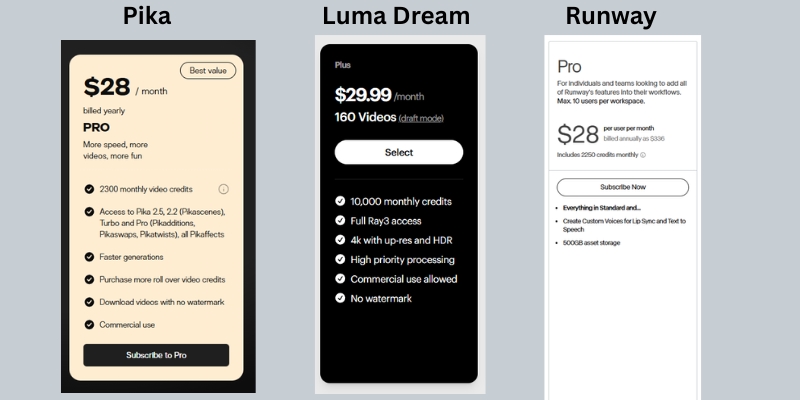
Luma vs. Runway Gen-4: Runway’s Standard plan costs $12/month with 625 credits, while Pro costs $28/month with 2,250 credits. Luma’s Plus plan ($29.99) offers 10,000 credits—significantly more value if you prioritize generation volume.
Luma vs. Pika Labs: Pika’s Pro plan at $35/month provides 2,300 credits with commercial rights. Luma’s Plus plan is cheaper while offering more than 4x the credits, making it more cost-effective for high-volume creators.
Luma vs. Kling AI: Kling’s Premier plan at $28.88/month offers 8,000 credits. Luma’s Plus plan edges ahead with 10,000 credits at a comparable price point, plus superior physics simulation.
Final Verdict: Which Plan is Best for You?
After extensive testing across all tiers, I have clear recommendations based on your role in the creative ecosystem.
Our Recommendations
The Hobbyist or Student: Start with the Free Plan. 500 credits monthly provides substantial room for learning prompt engineering and understanding AI motion without financial commitment.
The Content Creator (YouTuber/TikTok): Invest in the Plus Plan. The removal of watermarks and commercial rights are non-negotiable for monetized content. 10,000 credits support consistent posting schedules.
The Agency or Studio: The Unlimited Plan is essential. The relaxed mode eliminates credit anxiety during intensive project phases, and the fast credits ensure priority delivery for time-sensitive client work.
(Disclosure: If you purchase through links on this page, we may earn a small commission at no extra cost to you. This helps us maintain our “battle-tested” reviews.)
Frequently Asked Questions About Luma Pricing
Here are the answers to the most common questions we get from creators about the billing and credit specifics.
Do unused credits roll over to the next month? No. Monthly credits reset at the end of each billing cycle and do not carry over. However, purchased top-up credits are valid for 12 months and roll over until used.
Can I cancel my subscription anytime? Yes. You can cancel anytime, and you will retain access to your credits and features until the end of the current billing period.
Is there a student discount? Currently, Luma Labs has not announced a specific educational discount program. However, the Lite plan at $9.99/month serves as an affordable entry point for students.
How much do top-up credits cost? Top-up credit packs start at $4 for 1,200 credits. You can purchase multiple packs, and they remain valid for 12 months. They are automatically consumed after monthly credits are exhausted.
Read More From AI Generative Video
Expand your knowledge with these related guides on getting the most out of your AI video tools.
- How to Use Luma Dream Machine (Get Realistic Video)
- Pika Pricing Explained: Is the Pro Plan Worth It?
- The Future of AI Video: Trends & Predictions for 2026
last update : 06/12/2025