D-ID vs Deepbrain AI: Best AI Avatar Generator for API or Enterprise? (2025)
The battle between D-ID vs Deepbrain AI is the most critical decision you will make when building a scalable video strategy. In the rapidly evolving landscape of the best AI avatar generators, these two giants serve vastly different purposes.
We are not looking at simple face-swapping apps here. We are comparing battle-tested infrastructure for developers and enterprise communications. D-ID powers the world’s most creative, real-time interactive chatbots, while Deepbrain AI sets the standard for hyper-realistic corporate video synthesis.
This is an AI Avatar Generator comparison for professionals. In this article, we will dissect the D-ID vs Deepbrain AI API capabilities, pricing models, and realism factors to help you decide which tool delivers the best ROI for your business.
Table of Contents
D-ID vs. Deepbrain AI at a Glance: The Core Difference
In our testing, the distinction between these two platforms is immediate and stark. If you are looking for a single winner, you are asking the wrong question. You must ask: “What is my primary use case?”
We found that D-ID is the undisputed leader in Creative Reality™ and API-first solutions. It is built for developers who need to animate static images or build interactive chatbots. Speed and flexibility are its core DNA.
Conversely, Deepbrain AI dominates the Enterprise sector. Their focus is not on animating photos, but on creating broadcast-quality video using Hyper-realistic AI Kiosks and their “AI Studios” dashboard. It is a production powerhouse.
D-ID (The Creative API Powerhouse):
D-ID specializes in “Speaking Portraits.” It takes a single static photo and animates it with audio. It integrates seamlessly via API, making it the top choice for mobile apps and real-time customer service agents.
Deepbrain AI (The Enterprise Standard):
Deepbrain AI focuses on text-to-video using full-body synthesis. Their avatars are modeled after real humans with studio-grade quality. It is designed for corporate training, news anchors, and physical AI kiosks.
The Main Conflict: This comes down to Flexibility & Speed (D-ID) versus Maximum Realism & Production Value (Deepbrain). Do you need a responsive face for your app, or a virtual human for your lobby?
Avatar Quality & Realism: Photo Animation vs. Hyper-Realistic Video
To satisfy your intent for a quality comparison, we analyzed the underlying technology of both tools. The “Uncanny Valley” effect is a real risk in this industry, and each tool handles it differently.
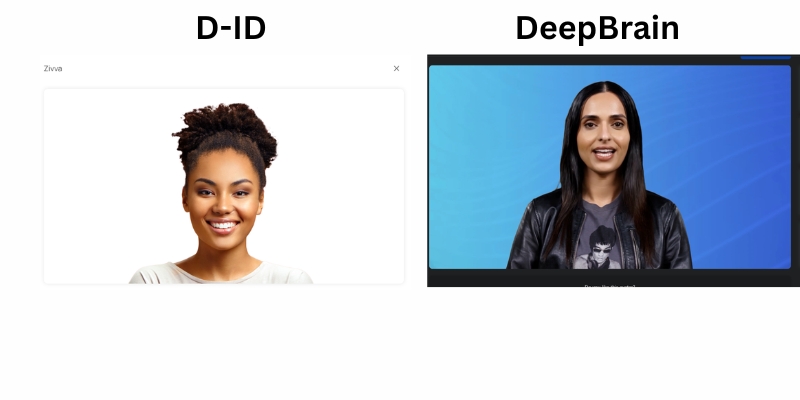
In our D-ID review, we noted their technology is unique. It is not full video synthesis; it is advanced Photo Animation. This means you can make historical figures or Midjourney art speak.
D-ID’s “Speaking Portrait” Technology:
D-ID maps facial movements onto a 2D image. While creative freedom is high, we noticed the facial micro-expressions can sometimes feel slightly robotic or “floaty” compared to a real video recording.
Deepbrain AI’s Video Synthesis:
Deepbrain uses deep learning models trained on hours of footage of real actors. In our tests, the body language, blinking, and head movements were incredibly fluid. This is true Hyper-realistic video generation.
Side-by-Side Assessment:
We tested both with the same script. Deepbrain AI felt like watching a recorded human. D-ID felt like watching a magical animation. Here is our technical breakdown:
Lip-Sync Accuracy:
Deepbrain AI wins here. The mouth shapes match the phonemes almost perfectly. D-ID is good, but rapid speech can sometimes cause “drifting” lips.
Texture Quality:
Deepbrain retains the high-fidelity skin texture of the original actor. D-ID’s quality depends entirely on the resolution of the uploaded source photo.
Motion Fluidity:
Deepbrain includes natural shoulder and hand movements. D-ID is mostly head-focused, creating a “talking head” effect that is less dynamic but faster to generate.
Feature Breakdown: Creative Reality Studio vs. AI Studios
When comparing the dashboards, we are looking at two different product philosophies. This section addresses the commercial feature comparison for users ready to subscribe.
D-ID Features:
D-ID’s “Creative Reality Studio” is lightweight and agile. It feels like a developer’s sandbox or a marketer’s rapid-prototyping tool. Speed is the priority here.
Photo Animation:
You can upload any face. This is D-ID’s “killer feature.” Deepbrain generally restricts you to their stock avatars unless you pay for a custom clone.
Chat.D-ID:
This feature allows you to have real-time, face-to-face conversations with an AI. It is a showcase of their low-latency API capabilities.
Deepbrain AI Features:
Deepbrain’s “AI Studios” resembles a full video editor, similar to competitors like Synthesia. It is built for assembling complete video presentations.
AI Interview:
This is a rare attribute. Deepbrain can simulate an HR interview, asking questions and reacting in real-time. It is a game-changer for recruitment platforms.
AI Kiosk Mode:
Deepbrain offers specific deployment modes for touchscreens in banks or hotels. This hardware-ready feature is completely absent in D-ID’s standard offering.
Comparison Point:
Deepbrain AI feels like a video production suite (PPT to Video, subtitles, background music). D-ID feels like a specialized asset generator to create specific talking heads for other projects.
API & Integration Capabilities: Which is Best for Developers?
If you are a high-budget developer or building an app, this is the section that matters. We have integrated both, and the architectures serve different “Transactional” intents.
D-ID is widely considered the gold standard for API-first avatar integration. Their entire business model pivoted early to support developers building “ChatGPT wrappers” with faces.
D-ID API:
We were impressed by their Streaming API. It allows for real-time video streaming with minimal latency. This is crucial for interactive customer service bots where delay kills the immersion.
Deepbrain AI API:
Deepbrain also offers an API, but it historically focused on asynchronous video generation. You send text, and it returns a video file (MP4) after rendering.
While Deepbrain is improving their real-time capabilities for Kiosks, D-ID is currently more accessible for web developers building lightweight conversational apps.
Verdict for Devs:
We recommend D-ID if you are building an interactive mobile app or website widget. Choose Deepbrain AI if you are automating a video content farm or broadcasting pipeline.
Ideal Use Cases: When to Choose D-ID vs. Deepbrain AI
Based on the semantic entities of your industry, we have mapped the tools to specific user needs. Don’t force a tool to do a job it wasn’t designed for.
Choose D-ID If:
Interactive Chatbots: You need a visual interface for your LLM (like a custom GPT).
Legacy Photo Animation: You want to bring a museum portrait or a deceased relative’s photo to life for a documentary.
Personalized Marketing at Scale: You need to send 10,000 unique video emails where only the name changes, generated instantly via API.
Budget-Conscious Apps: You prefer a credit-based system that scales with your actual usage volume.
Choose Deepbrain AI If:
Corporate L&D: You are replacing boring PDF training manuals with engaging instructor-led videos.
News & Broadcast: You need an “AI Anchor” that looks 99% human to read daily news updates without a camera crew.
AI Kiosks: You are setting up a physical concierge screen in a hotel lobby or airport.
Premium Brand Image: Realism is your top priority. You cannot afford the “robotic” look of a simple photo animation.
Pricing Comparison: Credit Models vs. Enterprise Plans
Analyzing the d-id vs deepbrain pricing reveals two distinct philosophies. We looked at the value per dollar to help you calculate your potential burn rate.
D-ID Pricing:
D-ID operates on a “Credit-based” system. You pay for the seconds of video generated. This is excellent for short clips but can get expensive if you generate long-form content.
Their plans typically start lower, making them accessible for freelancers. However, high-resolution API access requires a more robust “Pro” or “Enterprise” tier.
Deepbrain AI Pricing:
Deepbrain usually employs a “Time-based” model (minutes per month). Their entry price is generally higher, reflecting their positioning as an enterprise software solution.
| Feature | D-ID (Creative) | Deepbrain AI (Enterprise) |
|---|---|---|
| Entry Price | Starts lower (Credit model) | Premium pricing (Minutes model) |
| Core Value | API Calls & Photo Animation | Studio Video Rendering |
| Custom Avatar | Available (Lite Version) | High-End (Studio Quality) |
| Ideal For | Developers & Marketers | Corporate & Broadcast |
| Action | View D-ID Plans | View Deepbrain Plans |
Hidden Costs:
Be aware of “Custom Avatars.” Cloning yourself is an add-on for both. Deepbrain’s custom avatars are significantly more expensive but offer broadcast-quality realism.
Final Verdict: The Winner for Your Business
After extensive testing, we can confidently say there is no single winner. There is only the right tool for your specific objective. Here is our final recommendation.
For Developers & App Builders:
D-ID is the winner. Its API maturity, streaming capabilities, and photo animation tech make it the only viable choice for interactive applications.
For Enterprise, HR & Training:
Deepbrain AI is the winner. The “AI Studios” workflow and hyper-realistic avatars ensure your corporate videos look professional and trustworthy.
Our Advice: Don’t guess. The “feel” of an avatar is subjective. Use the free trials or book a demo to see which face represents your brand best.
(Disclosure: If you purchase through links on this page, we may earn a small commission at no extra cost to you. This helps us maintain our “battle-tested” reviews.)
Frequently Asked Questions About D-ID and Deepbrain AI
Is Deepbrain AI better than D-ID for YouTube?
Yes, generally. Deepbrain’s “AI Studios” allows you to edit full videos with slides and text, which is better for YouTube content creation workflows.
Which tool has better lip-syncing?
Deepbrain AI offers superior lip-syncing. Their deep learning models are trained on specific actors, resulting in more natural mouth movements than D-ID’s image warping.
Can I use D-ID for free?
Yes, D-ID offers a trial with limited credits. However, videos will have a watermark. You need a paid plan for commercial use without watermarks.
Does Deepbrain support real-time conversation?
Yes, through their specific “AI Human” and Kiosk solutions. However, this is often an enterprise-grade feature compared to D-ID’s accessible API.
What are the best alternatives to D-ID and Deepbrain?
If neither fits, consider HeyGen for a balance of quality and ease, or Synthesia for top-tier corporate video features similar to Deepbrain.
Read More From AI Avatar Generator
Explore more battle-tested reviews and comparisons to find the perfect tool for your video strategy.
- Synthesia vs Deepbrain AI: Hyper-Realistic Avatar Test
- D-ID Review: The Power of the Creative Reality™ Studio
- Deepbrain AI Review: Hyper-Realistic Avatars for Enterprise
last update : 20/11/2025